Best Practice Updates
Beyond Blame: Why Retraining Staff After Medication Errors Often Doesn’t Work
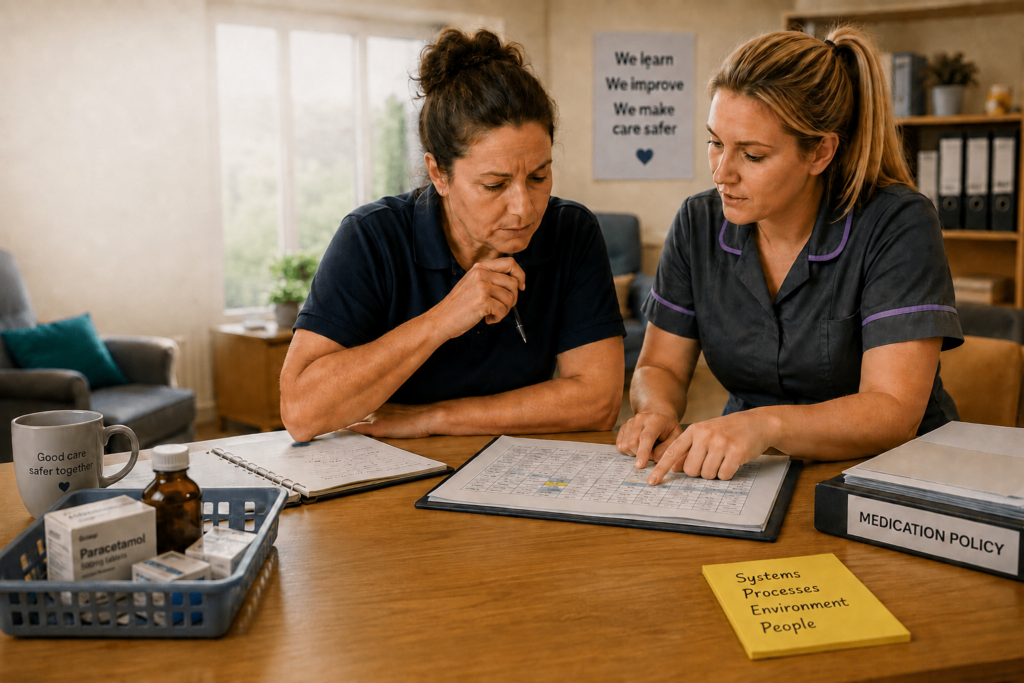

Retraining staff after a medication error may look decisive — but it rarely fixes the underlying causes
Over the last 20 years, we’ve gathered hundreds of medication error reports from our customers. Yet we tend to always see the same responses:
- Complete an incident form (report it)
- Check competency
- Re-attend medication training
- Remind everyone to be careful
It’s what I call “blame and retrain”, and it’s not usually the best approach.
Why do managers do it?
Because you’re understaffed, because you’re busy. Because you’re under pressure from directors, from Safeguarding, Local Authorities, and Care Inspectors (CQC and Care Inspectorate in Scotland or Wales).
They are expecting a response, it shows you’re taking it seriously.
But focusing solely on the individual isn’t always the best approach. We’ve all heard the phrase “to err is human”, we know people always make mistakes. But how many believe that if staff just try harder, if we stress the seriousness of what they’re doing, their performance will improve?
👉Join other care managers to learn a better way to manage errors
Dr Lucian Leape, a leading expert in patient safety and medical error, calls this the perfection myth: if people try hard enough, they’ll not make errors. He also describes the punishment myth: that punishing people for their errors will make them less likely to make mistakes in the future (2).
To understand why this approach does not work, we need to understand more about how the brain functions. The human brain has evolved over hundreds of thousands of years. Its main priority has always been survival. It’s good at quickly noticing things that might matter for safety: movement, threat, change, other people’s behaviour, and anything unusual in the environment. It can pick out one sound other another (tune in on one conversation over another), it’s great at recognising faces, patterns.
It also has another feature, that helps us pay attention to the world around us. When we learn a new task, we have to concentrate in order to perform it correctly. However, after a few repetitions, we can do the task ‘on autopilot’.
For example, when learning to drive, you have to concentrate on controlling the car: the pedals, the gears, the steering, road placement, indicating, mirrors, speed. You then also have to concentrate on what’s going on outside the car. It’s exhausting!
But soon, you can control the car automatically, without thinking. This leaves you free to concentrate on what’s happening outside (looking for danger). Can you see how carrying out routine tasks on ‘autopilot’ is a useful feature of the human brain that would help us survive?
So our brains are not naturally designed to maintain perfect, active concentration during detailed, repetitive tasks for long periods of time. This is great for survival, but it also means slips and lapses can happen, especially when people are distracted, interrupted, tired, under pressure or working in a familiar routine.
So what happens when we carry out a routine complex detailed task like a medication round. At first we check everything, the MAR chart, the label, the dosage instructions, the client. But soon our human biology takes over, and soon we can do this automatically. We select the medicine based on what it looks like, where it’s stored.
Sure, we read the label, but we see what we expect to see.

Did you notice “the” appears twice?
So you aren’t really reading the label. We can’t actively concentrate for more than a few minutes on detailed tasks, if we’ve carried them out many, many times before. They’ve become automatic behaviours. And you can’t undo hundreds of thousands of years of evolutionary biology by asking someone not to do this.
Beyond blame – a systems-first approach
The move towards relying on systems, rather than expecting people to just try harder, happened around the 1970s and 1980s after several disasters: Three mile island, Bhopal, the Challenger space shuttle, the fire at Kings Cross, and the Herald of Free Enterprise.
The Herald of Free Enterprise
On 6 March 1987 at just after 6pm, a car ferry, the Herald of Free Enterprise, was preparing to leave Zeebrugge in Belgium, for Dover. The member of crew whose job it was to close the bow doors (the Assistant Bosun) was asleep in his cabin.
The ship left harbour with its inner and outer bow doors fully open at the front of the ship. As the captain increased speed, water poured onto the vehicle deck. At around 18:27, the Herald capsized. I was 17 at the time and I remember seeing the pictures on the TV news. 193 people died, it was a terrible tragedy.
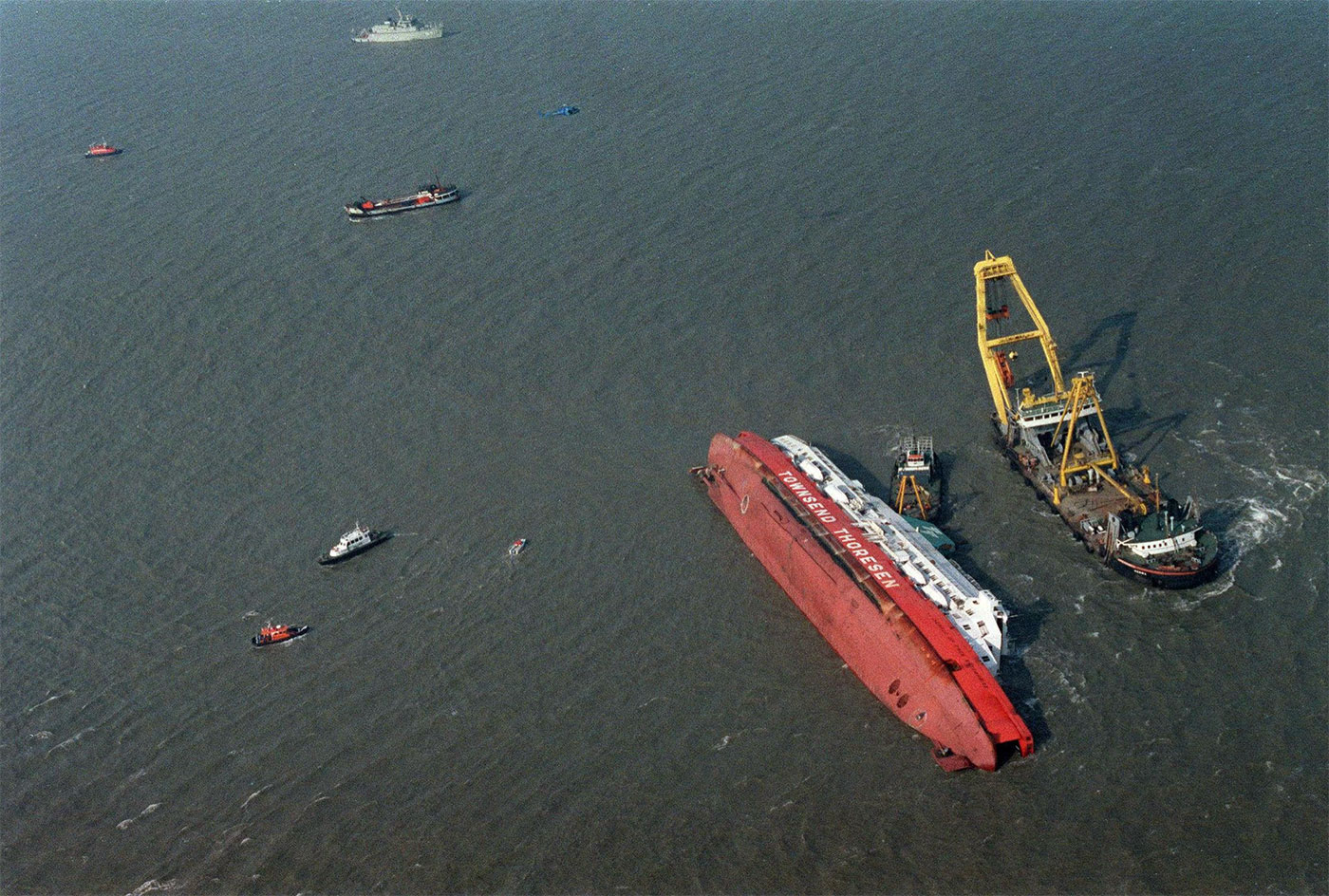
If this was investigated using a “blame and retrain” approach, the conclusion might seem obvious:
The person responsible for closing the doors (the Assistant Bosun) failed to do his job.
We could discipline him. Retrain him. Remind everybody that the doors must be closed before sailing. And we could tell ourselves that we had dealt with the problem.
But in his book “Human Error” (1) Professor James Reason explains why that would not solve the problem. The sleeping crew member was the last visible failure in a much larger system.
The Assistant Bosun had recently just finished carrying out maintenance and cleaning duties, and then slept when the ship sailed. So there was a rostering and workload problem making it difficult for him to check the doors were closed (problem 1).
No matter, his supervisor was on deck (he was the last to leave) so he could check. However, he saw the bow doors were open — but did not close them because that was not his job, that was the chief officer’s job (problem 2).
But the chief officer wasn’t on deck, he had instructions from the company to be on the bridge 15 minutes before departure (a memo from the operations manager pushed crews to sail early) (problem 3).
Then there was a reporting system. Company instructions relied on “negative reporting”: this meant unless the captain was told something was wrong, they could assume everything was all right. But the captain could not see the bow doors from the bridge (problem 4).
And even more strikingly, ship masters had repeatedly asked management for warning indicators on the bridge so they could tell whether the doors were open or closed. They had not been fitted (the cost was £400–£500) (problem 5).
Also, the ship had a chronic list to port (problem 6) and the ship was too top heavy in it’s design (problem 7). On the car deck, there were things called ‘scuppers’ – drainage openings to clear water from the vehicle deck, but they had never been adequate (problem 8). Also, because Zeebrugge had only a single loading ramp, so the ship had to fill it’s ballast tanks to sit lower in the water so that the ramp could reach the upper vehicle deck (problem 9).
Also, it was sailing fast out of the dock to leave early (problem 10). This caused more of a wave at the front of a top heavy ship that was already sitting low in the water without any warning system to tell the captain that the bow doors were still open.
It may sound odd, but car ferries like this often set sail before the doors were fully closed as the ship usually sat high in the water. It was just that on this occasion these 9 problems all added up to cause the ferry to sink.
If the investigation ended at “the Assistant Bosun was asleep and failed to close the doors”, we would these other 9 problems would have never been corrected.
Retraining or disciplining him would not have fixed the conflicting responsibilities. It would not have changed the pressure to sail early. It would not have installed a warning indicator on the bridge. It would not have corrected the reporting system, the ballast arrangements or the weaknesses in the ship’s design.
You can change the employee, but you haven’t changed the risk.
That is the lesson I want managers to take into medication error investigations. Check your systems and processes.
Saying someone “made a medication error” may accurately describe what happened, but it does not yet explain why it happened.
This is why we take you through how to investigate a medication error properly, rather than jumping straight to retraining the person involved.
Taking a systems-first approach doesn’t always take that long. We take you through example medication errors using our investigation form — which we call the OTL, or Opportunity to Learn, form — to guide you through the process of comparing what happened with what should have happened, identifying where the process broke down and deciding what genuinely needs to change.
Sometimes the answer will be training. Sometimes it will be competency. But often it will be something completely different: the procedure, the environment, interruptions, communication, equipment, workload or the way the process itself has been designed.
The action should follow the investigation — not come before it.
A systems-first approach does not mean no one is ever accountable. Occasionally, once you have investigated the system properly, you may still be left with a genuine concern about the decisions or behaviour of an individual member of staff.
So how do you decide what is fair?
- When is reflection enough?
- When is additional support or supervision appropriate?
- And when might an individual response genuinely be justified?
That’s why our Managing and Learning from Medication Errors course comes in two parts.
Part One – Beyond Blame teaches you how to investigate medication errors using a systems-first approach and identify changes that are actually likely to reduce the risk of recurrence.
Part Two – Being Fair looks at what happens when concerns about an individual remain after that investigation, and how to reach a fair and proportionate response without slipping straight back into blame.
The course gives you a practical way to investigate why an error happened, identify changes that will actually reduce risk, and then decide what a fair and proportionate response looks like when there are still concerns about an individual.
👉Click here to find out more about our Managing and Learning from Medication Errors course
References:
- Reason, J. (1990) Human Error. Cambridge: Cambridge University Press. ISBN: 978-0-521-31419-0.
- Leape, L.L. (2002) ‘Striving for Perfection’, Clinical Chemistry, 48(11), pp. 1871–1872. doi: 10.1093/clinchem/48.11.1871